Maximizing ROI on Your Leadership Strategy Session
Leadership
Vision & Strategy
Business Strategy Consulting & Coaching
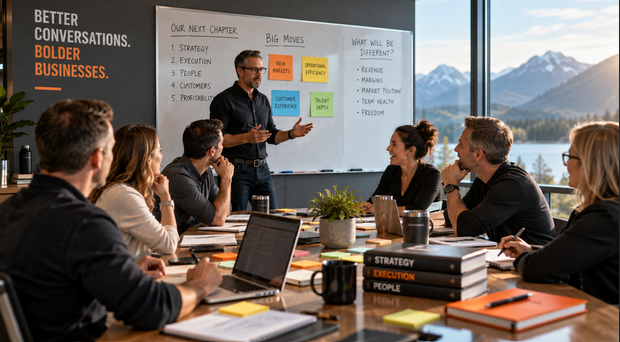
I shuddered when a client told me they do three- to four-day annual planning sessions and two-day quarterlies.
You’re probably thinking that that’s way too long. Mike’s going to tell them to cut it in half.
But that’s not where this is going.
My normal annual leadership strategy session is two days — action-packed, dense, no filler. With a brand-new client, it’s a one-day session first, then a two-day session about a month later. Clients need time to let their first session breathe. Give the team time to sit with what surfaced before you build on it.
The objection that comes from the client is usually not the duration of the session. It’s the density and the return on time.
Picture your leadership team in the room. CEO, CFO, COO, VP Sales, VP Ops, VP Marketing — eight, maybe ten people around the table.
Those aren’t eight salaries sitting there. Those are eight people who can make decisions worth hundreds of thousands or millions of dollars. The opportunity cost of that room running at half capacity dwarfs any facilitator fee. The question isn’t how many days you booked. The question is what you’re getting for every hour of the executive planning session.
Here’s the diagnostic I use: for every hour of your planning session, ask — what will be different in the business because we spent this hour together?
If there’s no good answer for this, give the team the hour back.
A great leadership team planning session should feel more like practice than a retreat. You don’t go to practice to bond for three hours and leisurely discuss how everyone feels about the season.
You show up prepared. You work hard. You think fast, decide fast, move fast. Then when game time comes, the other 250-ish working days of the year, the team is aligned and ready to execute.
The job of the session isn’t to feel good – it’s to make the rest of the year work.
Here’s where I’ll push back on the conventional wisdom. If we’re spending time together in one of these strategic planning sessions, it’s because we’re building something together:
If we’re in the room because that’s how long the retreat was booked for… no. The work sets the agenda, not the calendar.
We’re building the company’s operating infrastructure, and that’s worth every minute.
Dinners, social time, and connection are not the enemy of great planning sessions – they’re essential. They just need to live beside the session, not inside it.
Most of my clients do a team dinner after the first day. Some do a social activity the day before or the day after. That time is real. It builds the trust that makes the hard conversations in the room land.
The problem isn’t building the team. The problem is letting team-building activities bleed into session time and calling it all strategic planning. Keep them separate but protect both.
Before anyone gets in that room, remember that the work you do before you enter the room, the pre-work, really matters. CEOs and their teams need to arrive prepared with market and operational insights. The more ready people are when they walk in, the faster the session moves and the deeper it can go. Showing up cold to a planning session is a choice, and not a great one.
There’s a broader view of planning that all of this connects with, and it’s to:
What changes in the business because of the session is the outcome. A great planning session is invisible in the best possible way: nobody talks about how the session felt six months later. They talk about what the company did.
Every hour your leadership team spends together is either an investment or an expense. The difference isn’t how long you stay in the room. It’s whether you can answer one simple question when you leave:
What’s different now?
And if you can’t see what’s different, book a call with me. Let’s make the most out of your time.


