AI Business Coach: Transform AI into Your Personal Mentor
Thoughts
Business Strategy Consulting & Coaching

Last spring I sat down with a group of my peers to discuss AI and its impact in the world of business coaching. More than half the room was terrified, as they believed AI will (sooner than later) replace them.
When I was training with the awesome team at Gravitas Impact Premium Coaches, they talked about the 3 roles of a great business coach: Teacher, Advisor and Coach.
The value created by each role changes as you spend time with your coach. At first, it’s all about the teacher, but that fades as you learn the frameworks and get good at them. Later, advisor. But the role that provides the long-term value is coach.
IMHO: AI will never replace the coach role because of one key factor I’ll explain later. However, it can be great at the teacher and advisor roles and a great starting point in building a foundation on how to operate a successful business.
This guide is all about what AI can actually do, what it can’t, and prompts you can use to turn AI into your business coach.
So, what exactly does a business coach do?
A great business coach will listen. Question and challenge you. They’ll be your accountability coach. Much like a football team needs a coach on the sidelines to help see the vision and run the plays, business owners need a coach on the sidelines of their lives and businesses.
When it comes to AI, it isn’t going to replace human connection anytime soon. What it can do is act like that super-smart friend who’s always ready to brainstorm, offering insights and perspectives you might not have considered.
Before you start asking AI for advice, you need to set the stage. Think of it like briefing a new consultant who’s coming in to help—you wouldn’t just say, “Fix my business,” and leave it at that.
Take some time to reflect and jot down key aspects of your business:
What’s your business all about?
Who’s your target customer?
What are your core values?
What’s your brand’s personality?
How do you make money?
What are your goals?
What challenges are you facing?
By clarifying these points, you’re giving AI the context it needs to provide relevant and tailored advice.
Now let’s move on to the prompts. These prompts provide a great starting point in building your ultimate AI business coach. Simply enter these prompts into ChatGPT, Perplexity, Claude or your choice of AI
Developing an initial strategy is a great use of AI. Based on the information about your business you created earlier, you can ask the following question:
“I run an IT consulting firm specializing in cloud solutions for small to medium-sized businesses. I want to develop a comprehensive strategy to expand our client base and increase revenue over the next year. Can you help me outline a strategic plan with key steps and considerations tailored to my business?”
This is a fantastic question. And one that can open the door to potential follow up questions in terms of tactics. It helps you brainstorm actionable steps tailored to your business.
Potential follow-up: You might then ask, “What are potential obstacles I should be aware of?” or “How can I differentiate myself from competitors?”
Suppose you’re not entirely sure who your most profitable customers are. You could say:
“I run a small graphic design agency specializing in branding for startups. Can you help me identify different customer segments within this market?”
The AI might break down your audience into tech startups, eco-friendly businesses, or local entrepreneurs. Maybe it will raise your eyebrow. Maybe you’ve worked with 1 or 2 of the segments mentioned, and you can double down on your strategy. Maybe it will open your eyes to new markets and demographics.
Potential follow-up: Ask, “Which of these segments has the highest growth potential?” or “How should I tailor my services to appeal to each group?”
Maybe you’ve got a massive project that feels overwhelming. Try framing it like this:
“I have a project to implement a new CRM system throughout our consulting firm. It’s a bit overwhelming. Can you help me break it down into manageable tasks and milestones so I can assign them to my team effectively?”
The AI can outline steps: defining your objectives, who internally should be involved, timelines, and how to measure success / failure.
Potential follow-up: Delve deeper by asking, “What timeline should I aim for each task?” or “How can I effectively delegate these tasks to my team?”
If you’re unsure what metrics to track, you might ask:
“As the CEO of an IT services company focusing on network infrastructure, what are the top Key Performance Indicators (KPIs) I should track to measure operational efficiency and client satisfaction?”
The AI could suggest metrics like monthly recurring revenue, customer churn rate, user engagement levels, and acquisition costs.
Why it’s good: It zeroes in on the numbers that matter most to your business model.
Potential follow-up: Ask about leading and lagging indicators and KPIs. Understand how these are different and how they affect strategy going forward.
You’re a CEO. You don’t have time… I get it. There are tons of books I recommend that provide amazing value. Here’s an example of a prompt that will break down one of the books I recommend a lot!
“Can you summarize the key leadership principles from Jim Collins that are relevant to a mid-sized tech company?”
The AI might explain concepts like Level 5 Leadership, the Hedgehog Concept, or the importance of getting the right people on the bus.
Why it’s good: It distills complex ideas into digestible insights you can apply immediately.
Potential follow-up: Probe further with, “How can I cultivate Level 5 Leadership qualities?” or “What does the Hedgehog Concept look like for my company?”
You might be grappling with your role and where to draw the line. Try asking:
“What’s the difference between being accountable and being responsible as a CEO, and how does that impact my daily actions?”

The AI can explain that accountability is about owning the outcomes, while responsibility is about completing specific tasks.
Potential follow-up: Consider asking, “How can I foster a culture of accountability within my team?” or “What responsibilities should I delegate to empower others?”
This is an exercise I carry out with all my clients. And you can get a decent answer with this prompt:
“What are the six key questions every business should answer to ensure long-term success?”
You’ll get a list of questions like, why do we exist? How do we behave? What we do? And it’s up to you to sit down and answer these foundational questions. This is the part where you SHOULD NOT ask AI. You have to find these purposes from within.
EOS is a fantastic growth system (if implemented properly). It definitely takes time. And you might be wondering if it’s “right for me.” So, ask this:
“I’m intrigued by the Entrepreneurial Operating System. Can you guide me through the steps to implement EOS in my company?”
The AI can outline steps like establishing your vision, setting quarterly rocks (goals), holding regular meetings, and tracking key metrics.
Why it’s good: It provides a clear roadmap for operational efficiency.
Potential follow-up: Ask, “Which step should I prioritize first based on my company’s current situation?” “How do I get buy-in from my leadership team?” or “Do I need an EOS implementor or coach?”
To be an effective leader, you absolutely MUST know how to create an employee scorecard. You hold yourself accountable, don’t you? So, you should do the same thing with staff. Try this:
“How can I create an effective scorecard to measure my employees’ performance in a way that’s fair and motivating?”
The AI might suggest identifying key performance areas, setting measurable goals, and incorporating both quantitative and qualitative metrics.
Potential follow-up: Explore, “How often should I review these scorecards with my team?” or “What’s the best way to provide constructive feedback based on the scorecards?”
While AI is becoming a great tool to learn, research and formulate strategy, there’s a superpower it will never have.
It can’t connect, person to person.
That’s the key thing that those coaches in the room were missing. For all their knowledge, they were forgetting their true superpower.
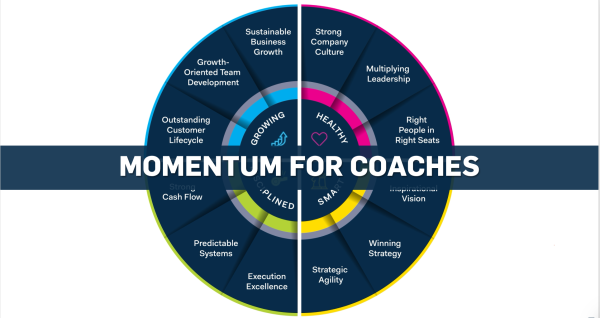
When I talk about building a great business, I describe it as being healthy (great culture, right people, strong leadership), disciplined (awesome execution, great systems, good cash) and smart (clear vision, winning strategy). Looking through that lens, AI is a non-factor in ⅔ elements.
Yes, it can teach you how to uncover your core values, but it can’t work with you to develop your leadership. It can’t read the room and nurture the right behaviours in real-time (or prune the bad ones). It can’t connect with the people and help them level up.
Yes, it can create a rough execution plan, but would you care if you let your AI down by now being accountable? So many teams put in that extra sprint at the end of the quarter to look good in session with me.
Would you want to talk to an AI about that terrible meeting you had and develop an action plan? How about discussing the fact that you have to fire a key employee (and deal with the emotions involved)?
It’s a coach’s job to be there when you need them. To connect and be a wise advisor and help you reflect clearly so you can make great decisions. AI can help you intellectually see all the factors, but without human connection, it can’t see the whole picture.
At the end of the day, AI isn’t going to replace the human touch, but it can be a powerful ally in your entrepreneurial journey. It’s like having a brainstorming buddy who’s always available, doesn’t judge, and can pull from a vast pool of knowledge.
Use AI to:
But remember:
So go ahead, give AI a shot. Engage in conversations, challenge it, see where it takes you. You might just find that it complements your skills and frees up time to focus on what you do best.
Remember, AI is here to assist—not to take the wheel.